
- Understanding COB LED Technology
- Traditional LED Strip Characteristics
- Performance Comparison Analysis
- Light Quality and Uniformity
- Thermal Management
- Seamless COB LED Solutions in Australia
- Installation Methodologies
- COB LED Strip Installation Requirements
- Traditional LED Strip Installation
- Cost-Benefit Analysis
- Application Scenarios and Recommendations
- Optimal COB Applications
- Traditional Strip Advantages
- Future Considerations
Understanding COB LED Technology
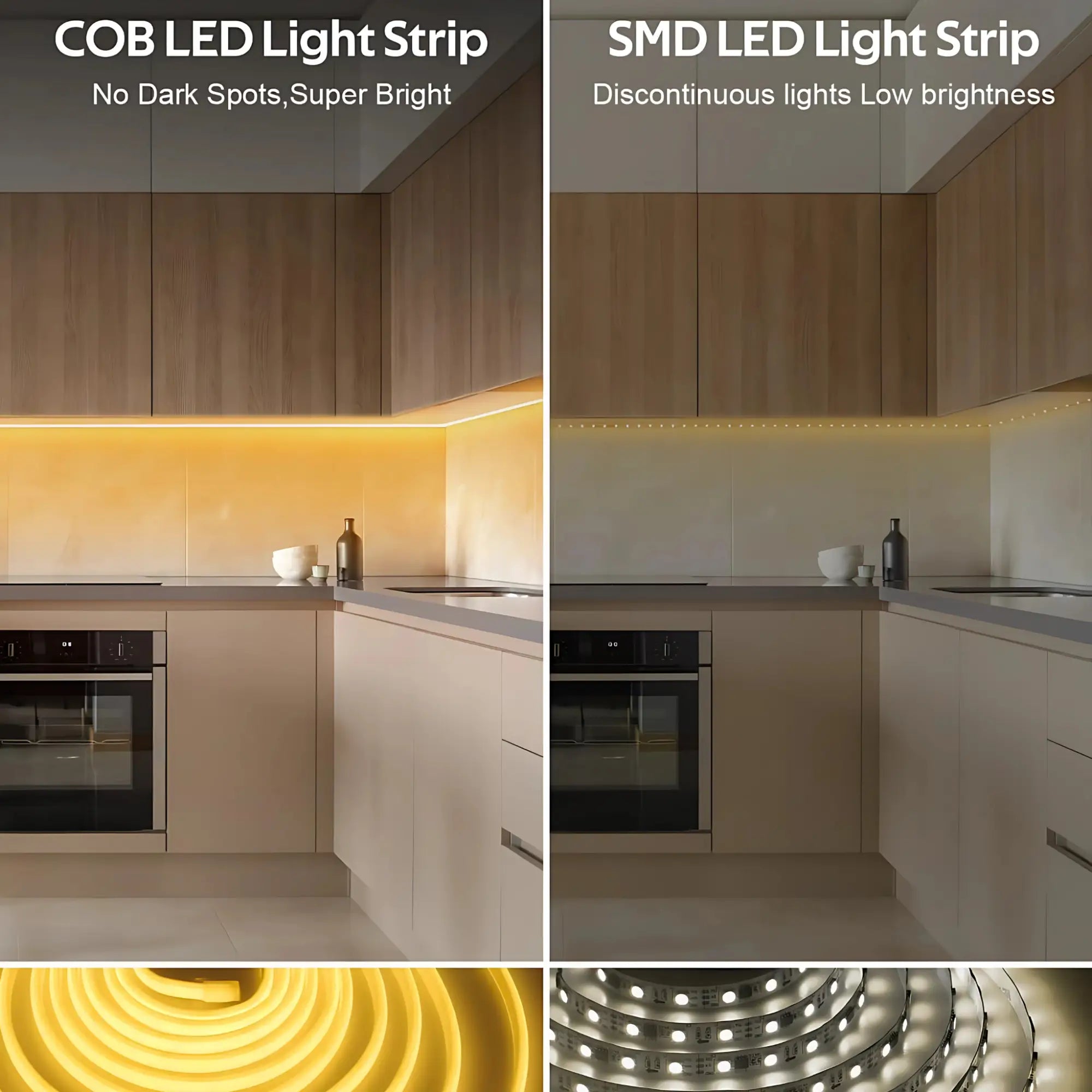
Chip-on-Board (COB) LED technology represents a revolutionary advancement in illumination engineering, fundamentally transforming how we perceive and implement linear lighting solutions. Unlike conventional LED strips that feature discrete diodes positioned at intervals, COB technology integrates multiple semiconductor chips directly onto a substrate, creating an uninterrupted luminous surface.
This architectural innovation eliminates the characteristic "dotting effect" associated with traditional LED configurations. The result? A seamless photonic output that mimics the smooth, continuous illumination of fluorescent fixtures while maintaining the energy efficiency and longevity inherent to solid-state lighting technology.
COB strips achieve their distinctive uniform appearance through high-density chip placement, typically featuring 480-840 LEDs per meter compared to traditional strips' 60-120 LEDs per meter. This exponential increase in diode density, combined with advanced phosphor coating techniques, produces exceptionally smooth light distribution without visible hotspots or shadowing effects.
Traditional LED Strip Characteristics
Conventional LED strip lighting employs individual surface-mounted device (SMD) LEDs positioned at predetermined intervals along a flexible circuit board. These configurations typically utilise 5050, 2835, or 3528 SMD packages, each containing one to three semiconductor chips housed within distinct enclosures.
The spacing between individual LEDs creates the familiar "pearl necklace" effect when viewed directly or when light reflects off surfaces. While this characteristic may be acceptable for accent lighting or hidden installations, it becomes problematic in applications requiring smooth, uniform illumination such as cove lighting, architectural features, or professional photography environments.
Traditional strips excel in cost-effectiveness and widespread availability. Their modular construction facilitates easy repairs, as individual LED failures don't compromise entire sections. However, this segmented approach inherently limits their applications where seamless illumination is paramount.
Performance Comparison Analysis
Light Quality and Uniformity
The photometric performance differential between COB and traditional LED strips is substantial and measurable. COB technology achieves superior luminous uniformity, typically registering uniformity ratios exceeding 0.9, while conventional strips often struggle to surpass 0.7 ratios due to their discrete light source configuration.
Colour rendering capabilities also favour COB implementations. The continuous phosphor coating across the chip array enables more consistent spectral output, resulting in improved Colour Rendering Index (CRI) values often exceeding 90+. Traditional strips, with their individual phosphor-coated LEDs, may exhibit slight colour temperature variations between diodes, particularly in lower-quality manufacturing.
"The absence of visible LED points in COB strips creates an almost ethereal lighting quality that transforms architectural spaces, providing the sophistication of professional linear fixtures at a fraction of the installation complexity." - Lighting Design Professional
Thermal Management
Heat dissipation characteristics differ significantly between the two technologies. COB strips distribute thermal loads across continuous substrate surfaces, promoting more efficient heat spreading. However, this concentration of heat generation requires robust thermal management solutions, often necessitating aluminum extrusions or heat sinks for optimal performance.
Traditional LED strips, conversely, distribute heat generation across discrete points, potentially reducing localised thermal stress but requiring careful consideration of cumulative heat buildup in extended installations.
Seamless COB LED Solutions in Australia
Australian lighting enthusiasts and professionals increasingly recognize the transformative potential of seamless COB LED technology. Green Earth Lighting's comprehensive COB LED strip lighting collection addresses the growing demand for dotless, professional-grade linear illumination solutions across residential and commercial applications.
This curated selection encompasses various configurations, from ultra-high-density strips delivering museum-quality illumination to IP-rated weatherproof options suitable for Australia's diverse climate conditions. Each product undergoes rigorous testing to ensure performance consistency under the demanding Australian environment, from tropical humidity to arid heat.
The collection specifically addresses common challenges faced by renovators and designers: achieving professional lighting aesthetics without complex installation requirements, sourcing reliable products with prompt nationwide delivery, and accessing competitive pricing on premium lighting technology.
Installation Methodologies
COB LED Strip Installation Requirements
COB LED strip installation demands meticulous attention to thermal management and substrate preparation. The continuous chip arrangement generates concentrated heat loads requiring adequate dissipation pathways. Aluminum profiles with integrated heat sinking capabilities are essential for installations exceeding 5 meters or high-density configurations.
Power distribution planning becomes critical due to COB strips' higher current requirements. Calculate voltage drop meticulously, implementing power injection points every 3-5 meters for optimal performance. Utilize appropriately rated drivers with sufficient current capacity and consider dimming compatibility if future control integration is anticipated.
- Surface preparation: Clean installation surfaces thoroughly, ensuring smooth, debris-free mounting areas
- Profile selection: Choose aluminum extrusions matching strip width and thermal requirements
- Power calculation: Determine total wattage and implement adequate driver sizing with 20% overhead
- Mounting methodology: Secure profiles using appropriate fasteners for substrate material
- Strip installation: Apply COB strips carefully, avoiding stretching or compression that may damage chip connections
- Connection execution: Utilize proper soldering techniques or compatible connectors designed for COB applications
Traditional LED Strip Installation
Conventional LED strips offer installation flexibility due to their lower thermal generation and standardized connection systems. The discrete LED arrangement tolerates minor installation irregularities better than COB configurations, making them suitable for DIY enthusiasts and quick deployment scenarios.
Standard 12V or 24V strips accommodate longer runs between power injection points, typically supporting 10-15 meter continuous lengths before voltage drop becomes problematic. This characteristic simplifies power distribution planning and reduces component requirements.
Cost-Benefit Analysis
Initial investment considerations reveal COB technology commanding premium pricing, typically 40-60% higher than equivalent traditional strips. However, comprehensive cost analysis must encompass installation complexity, component requirements, and long-term performance characteristics.
COB installations often eliminate the need for diffusion materials and specialized profiles required to mask traditional LED spacing, potentially offsetting initial cost premiums. The professional appearance achieved with COB technology may justify higher investment in applications where aesthetics directly impact project value.
| Aspect | COB LED Strips | Traditional LED Strips |
|---|---|---|
| Initial Cost | Higher (Premium pricing) | Lower (Standard pricing) |
| Installation Complexity | Moderate (Thermal management required) | Simple (Standard mounting) |
| Light Quality | Exceptional (Seamless output) | Good (Visible segmentation) |
| Thermal Requirements | High (Heat sinking essential) | Moderate (Standard ventilation) |
Application Scenarios and Recommendations
Optimal COB Applications
COB LED strips excel in applications demanding uncompromising light quality and visual sophistication. Architectural cove lighting, display illumination, and residential accent lighting benefit tremendously from the seamless output characteristics. Photography studios, art galleries, and retail environments where color accuracy and uniform illumination are paramount represent ideal COB applications.
Kitchen under-cabinet lighting transforms dramatically with COB implementation, eliminating shadows and hotspots that compromise task lighting effectiveness. Bathroom vanity lighting achieves professional makeup artist quality when utilizing high-CRI COB strips with appropriate color temperature selection.
Traditional Strip Advantages
Conventional LED strips remain optimal for utility applications, outdoor perimeter lighting, and installations where initial cost constraints dominate decision-making. Their robust construction tolerates environmental challenges effectively, while standardized components ensure easy maintenance and replacement.
Garage lighting, workshop illumination, and security applications benefit from traditional strips' straightforward implementation and reliable performance. The discrete LED arrangement actually provides advantages in applications requiring specific beam angle control or focused illumination patterns.
Future Considerations
The Australian lighting market continues evolving toward premium solutions emphasising sustainability, performance, and aesthetic excellence. COB technology represents this progression, offering professional-grade results previously accessible only through expensive linear fixtures.
Smart home integration capabilities favour COB strips due to their superior dimming characteristics and colour consistency across brightness levels. As home automation adoption accelerates, the seamless integration of COB strips with intelligent lighting systems positions them as future-ready solutions.
Energy efficiency regulations and sustainability initiatives increasingly influence lighting decisions. COB technology's improved efficacy and longer operational lifespans align with environmental consciousness while delivering superior user experiences.
Consider your specific application requirements, budget constraints, and performance expectations when selecting between COB and traditional LED strips. Both technologies serve distinct purposes within the comprehensive lighting ecosystem, and understanding their respective strengths enables informed decision-making for your Australian lighting projects.