
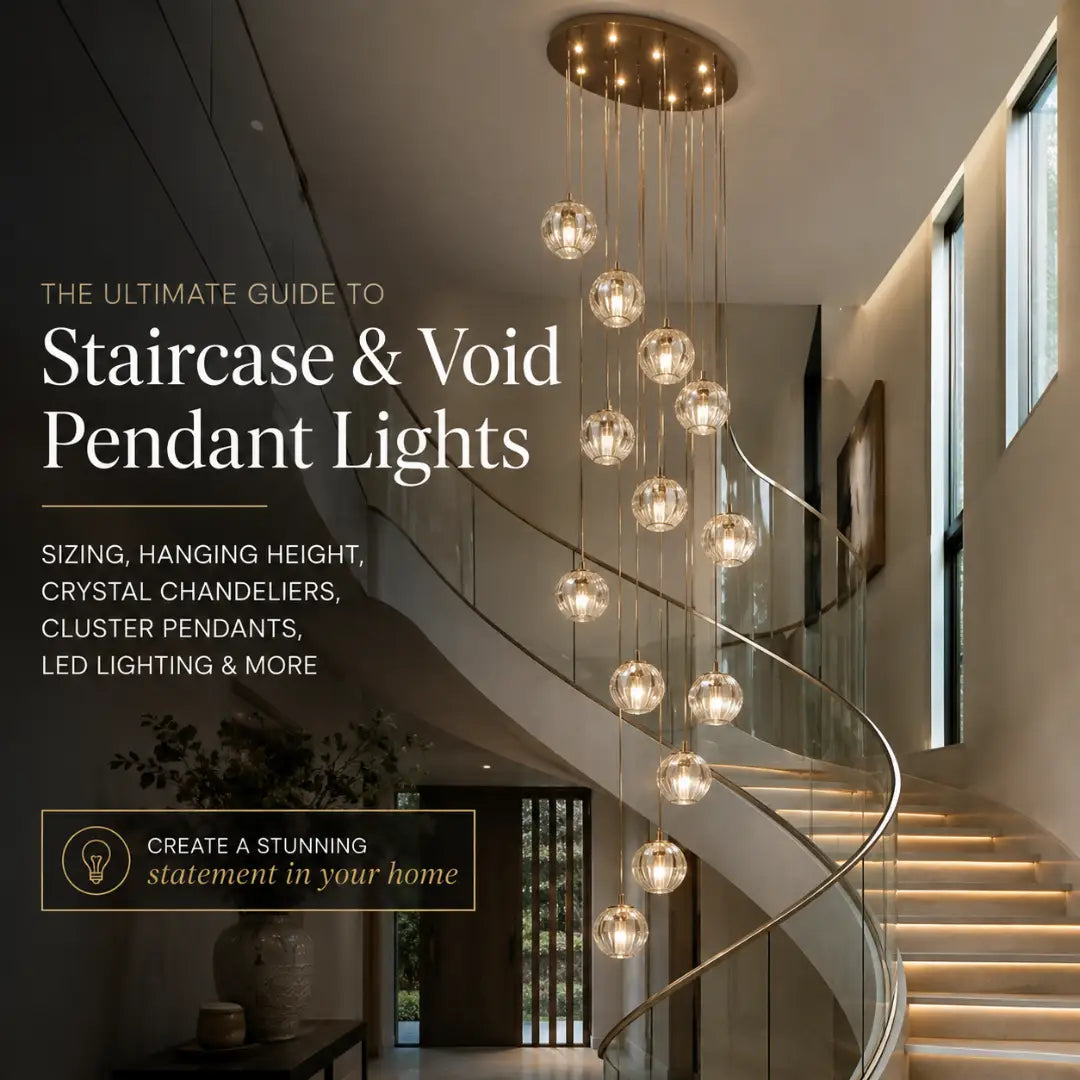
The Ultimate Guide to Choosing Staircase & Void Pendant Lights in Australia
A staircase or double-height void is one of the best opportunities in a home to create a truly spectacular lighting feature. With additional ceiling height, open sightlines and multiple viewing angles, these spaces allow you to use larger and more dramatic lighting than you might choose for a standard room.
From cascading cluster pendant lights and elegant crystal chandeliers to contemporary LED pendants and oversized statement lights, the right fixture can transform an otherwise empty stairwell or void into an architectural feature.
But choosing a staircase pendant isn't simply about finding a light you love. Size, shape, drop height, ceiling height, light output, viewing angles and the proportions of the void all need to be considered.
This guide explains how to choose the right staircase and void pendant lights in Australia, including how to determine the correct size and hanging height and which lighting styles work best in different spaces.
Why Staircase & Void Lighting Is So Important
Unlike lighting in a standard room, a pendant installed in a staircase or void can often be seen from several levels and viewing positions. This means the fixture effectively becomes part of the architecture.
Good void lighting performs three important functions:
- Functional lighting – provides useful illumination around stairs, landings and surrounding spaces.
- Ambient lighting – creates warmth and atmosphere throughout the entrance or stairwell.
- Feature lighting – fills the vertical space and creates a visual focal point.
In many contemporary Australian homes, the staircase or entrance void is one of the largest uninterrupted spaces in the house. Leaving it with an undersized light can make the space feel unfinished.
The right statement pendant or chandelier gives the void purpose and draws the eye upward, emphasising the height and architecture of the home.
Shop Staircase & Void Pendant Lights →
How to Choose the Right Staircase or Void Pendant Light
1. Start With the Ceiling Height
The first measurement to consider is the total height from the ceiling mounting point to the lowest floor below.
Standard ceiling lighting rules don't necessarily work in a double-height space. A pendant that looks large in a showroom with a 2.4-metre ceiling may appear surprisingly small when installed in a 5 or 6-metre void.
As the ceiling becomes higher, you generally have more opportunity to use:
- Longer pendant drops
- Larger chandeliers
- Cascading arrangements
- Multi-tier fixtures
- Vertical LED pendants
- Multi-light clusters
The objective is to use the vertical space rather than simply hanging a light from the top of it.
Typical Double-Height Void
For a void approximately 4.5 to 6 metres high, a fixture with substantial vertical presence will usually look more proportional than a conventional pendant designed for a standard ceiling.
For particularly tall architectural voids, consider fittings specifically designed with long suspension cables or adjustable drops.
How Big Should a Void Pendant Light Be?
One of the most common mistakes with staircase lighting is choosing a fixture that is too small.
A pendant can look enormous when you see its dimensions online but considerably smaller once suspended several metres above the floor.
Rather than looking only at the diameter of the fixture, consider its overall visual volume. A chandelier measuring 800mm wide but 1200mm tall creates a very different impression from a flat 800mm-wide pendant.
Small Stairwells
For narrower staircases or smaller voids, consider:
- Slim vertical pendants
- Compact cluster lights
- Single elongated pendants
- Smaller chandeliers
- Narrow cascading fixtures
Medium Double-Height Voids
Medium-sized voids can accommodate:
- Multi-light cluster pendants
- Medium-to-large chandeliers
- Cascading glass pendants
- Vertical LED pendants
- Sculptural statement lights
Large Entrances & Grand Voids
Large architectural spaces can support significantly more dramatic lighting, including:
- Oversized chandeliers
- Large crystal chandeliers
- Multi-tier chandeliers
- Long cascading cluster pendants
- Large sculptural LED installations
- Multiple pendant arrangements
In these spaces, being too conservative with size can actually reduce the visual impact of the architecture.
Match the Shape of the Light to the Shape of the Void
Tall & Narrow Stairwells
A long vertical fitting often works best. Look for:
- Cascading pendants
- Long crystal chandeliers
- Vertical LED pendants
- Staggered cluster pendants
- Multi-drop glass pendants
Wide or Square Voids
A broader chandelier or sculptural pendant can fill the space more effectively. Consider:
- Circular chandeliers
- Ring chandeliers
- Large globe clusters
- Wide crystal chandeliers
- Multi-arm chandeliers
Long Staircases
For long staircases, a fixture with horizontal movement can complement the direction of the stairs. Linear pendants, elongated chandeliers and staggered multi-light installations can work particularly well.
Tall space = emphasise vertical form.
Wide space = consider greater width.
Long space = consider horizontal or staggered arrangements.
How Low Should a Staircase Pendant Hang?
Hanging height is just as important as fixture size. The light needs to sit low enough to feel connected to the space but high enough that it doesn't interfere with people using the staircase or surrounding walkways.
A commonly used starting point is to maintain approximately 2.1 to 2.4 metres of clearance above areas where people can walk directly underneath the fixture.
However, every staircase is different. You also need to consider:
- Stair trajectory
- Upper-level balustrades
- Nearby doors
- Windows
- Landings
- Sightlines from the ground floor
- Sightlines from the upper floor
Use the Upper Floor as a Viewing Position
A beautiful chandelier shouldn't look perfectly positioned downstairs but awkward when viewed from the first-floor landing.
Ideally, the fixture should feel visually balanced from both levels of the home. For adjustable multi-drop pendants, the individual lights can often be arranged at different heights to achieve this balance.
Crystal Chandeliers for Staircases & Voids
Create a Luxurious Architectural Centrepiece
Few lighting styles create the same sense of grandeur as a crystal chandelier in a staircase or entrance void.
Crystal works particularly well in double-height spaces because light interacts with the individual crystals from multiple angles, producing reflections and sparkle as you move through the staircase.
Contemporary crystal chandelier styles include:
- Crystal ring chandeliers
- Cascading crystal pendants
- Rectangular crystal chandeliers
- Multi-tier crystal designs
- Minimalist LED crystal chandeliers
- Vertical crystal installations
Where Crystal Chandeliers Work Best
- Grand entrances
- Luxury staircases
- Double-height foyers
- Large modern homes
- Formal entrances
- Statement voids
Choosing the Right Crystal Chandelier
Look carefully at both the width and total height of the fitting. For a tall void, a chandelier with multiple tiers or significant vertical length will generally make better use of the available space.
For a wide entrance, a broader chandelier may create better proportions.
Featured Crystal Chandeliers
Explore crystal chandeliers designed to create a dramatic focal point in staircases, entrances and double-height voids.
Cluster Pendant Lights for Staircases
One of the Most Versatile Choices for a Void
Cluster pendant lights are particularly effective in stairwells because individual pendants can be suspended at different heights.
Instead of one large object, the cluster creates a flowing installation through the vertical space.
Popular cluster styles include:
- Glass globe clusters
- Crystal clusters
- Smoke glass pendants
- Amber glass pendants
- Metallic pendants
- LED clusters
- Multi-drop decorative pendants
Why Cluster Pendants Work So Well
A cascading arrangement naturally follows the height of a staircase. Depending on the fixture, different drops may also be positioned to complement the direction of the stairs.
Clusters are especially useful when you want a dramatic statement without the visual weight of a traditional chandelier.
Featured Cluster Pendant Lights
Discover multi-light and cascading pendant designs ideal for staircases and double-height spaces.
Cascading Pendant Lights for Tall Voids
Cascading pendants are designed to take advantage of vertical space. Individual lights descend at different heights, creating movement from the ceiling downward.
They are particularly effective for:
- Two-storey stairwells
- Three-storey stairwells
- Narrow voids
- Tall entrance halls
- Spiral staircases
Glass, crystal and LED cascading pendants can produce very different aesthetics, from glamorous and luxurious to minimalist and contemporary.
For very tall voids, always check the maximum suspension length before purchasing.
Modern LED Staircase Pendant Lights
Integrated LED technology has opened up entirely new possibilities for void lighting.
Modern LED fixtures can create sculptural forms including:
- Illuminated rings
- Vertical light bars
- Spirals
- Suspended curves
- Geometric forms
- Minimalist linear pendants
These styles are particularly effective in contemporary Australian homes where the lighting itself becomes a piece of architectural sculpture.
Consider Dimmable LED Lighting
A large staircase fixture can produce substantial light output. Where compatible with the fitting and installation, dimming allows you to reduce the brightness in the evening while maintaining the visual effect of the pendant.
Ring Chandeliers for Double-Height Voids
Circular and ring chandeliers are a popular option for contemporary staircases.
Single-ring designs provide a clean architectural appearance, while two- and three-tier arrangements create greater vertical presence.
Ring chandeliers work particularly well in:
- Square voids
- Modern entrances
- Open-plan homes
- Contemporary staircases
- Homes with glass balustrades
For taller spaces, multiple rings positioned at different heights can create a dramatic floating effect.
Featured Ring Chandeliers
Explore modern ring chandeliers for staircases, voids and contemporary entrance spaces.
Large Statement Pendant Lights
Sometimes the architecture calls for one dramatic fixture. An oversized statement pendant can create a strong focal point without requiring multiple lights.
Popular materials include:
- Glass
- Brass
- Marble
- Crystal
- Timber
- Metal
- Stone
- Acrylic
The key is ensuring the fixture has sufficient scale. A large pendant should look intentionally oversized rather than simply slightly larger than a normal pendant.
Shop Statement Pendant Lights
Browse oversized and designer pendant lights for dramatic entrance spaces and architectural voids.
Linear Pendant Lights for Staircases
Linear pendants aren't just for kitchen islands and dining tables.
In the right staircase, a long linear fitting can visually follow the direction of the stairs and create a strong architectural line.
They are particularly effective in homes featuring:
- Straight staircases
- Long voids
- Minimalist interiors
- Architectural concrete
- Glass balustrades
- Modern open-plan designs
For long staircases, consider whether the pendant should run parallel with the staircase to reinforce the architecture.
Grand Lighting: When Should You Go Big?
A large void is one of the few spaces in a residential home where dramatic lighting can genuinely feel appropriate rather than excessive.
Think of the fixture as part of the architecture rather than simply a source of illumination.
Grand lighting works particularly well when the home features:
- A double-height entrance
- A sweeping staircase
- Floor-to-ceiling windows
- Large open voids
- Architectural staircases
- Glass balustrades
- Luxury finishes
In these situations, the lighting can act as the visual connection between the ground and upper floors.
The Wow Factor
If your staircase is one of the first things visitors see when entering the home, lighting deserves particular attention.
A dramatic chandelier or cascading pendant immediately draws the eye upward and emphasises the scale of the entrance.
During the day, the fitting becomes a decorative sculpture. At night, it becomes the illuminated centrepiece of the space.
That's the real function of grand lighting: it provides illumination while simultaneously defining the architecture of the home.
Choosing the Right Colour Temperature
Warm White – Around 3000K
Warm white creates an inviting, comfortable atmosphere and works particularly well with:
- Timber
- Brass
- Stone
- Marble
- Warm interior colours
- Traditional interiors
Neutral White – Around 4000K
Neutral white produces a cleaner, more contemporary appearance and can work well with:
- White interiors
- Concrete
- Black fittings
- Modern architecture
- Minimalist spaces
Where available, CCT-selectable lighting provides additional flexibility by allowing the colour temperature to be selected during installation.
How Much Light Does a Staircase Need?
A staircase pendant shouldn't be chosen purely on appearance. The space also needs practical illumination.
Consider whether the feature light will provide the main illumination or whether it will work together with:
- Recessed downlights
- Wall lights
- Step lights
- LED strip lighting
- Natural daylight
In many premium lighting designs, the chandelier or pendant provides the feature and ambient lighting, while discreet architectural lighting provides additional functional illumination.
This layered approach can produce a far more sophisticated result than relying on one extremely bright fixture.
Think About Daytime Appearance Too
A void pendant spends more time switched off than switched on, which means its physical appearance is extremely important.
Ask yourself: Does this fixture still look impressive when it isn't illuminated?
Crystal, glass, marble, brass and sculptural LED fixtures can all act as decorative features during daylight hours.
Choosing Lighting for Different Interior Styles
Contemporary Homes
- LED ring chandeliers
- Geometric pendants
- Black finishes
- Linear pendants
- Minimalist cluster lights
Luxury Interiors
- Crystal chandeliers
- Cascading crystal lights
- Brass finishes
- Large multi-tier chandeliers
- Statement glass fixtures
Coastal & Natural Interiors
- Glass pendants
- Timber
- Natural materials
- Lighter finishes
- Warm illumination
Industrial Interiors
- Black metal
- Exposed lamps
- Smoked glass
- Architectural linear fittings
- Darker finishes
Don't Forget the Ceiling Structure
Before choosing a large chandelier or pendant, consider the ceiling structure and mounting location.
Large fixtures can be substantially heavier than standard residential pendant lights. The installer may need to consider:
- Ceiling structure
- Mounting reinforcement
- Fixture weight
- Electrical connection
- Suspension method
- Ceiling angle
- Accessibility
This is particularly important for large crystal chandeliers.
Sloped Ceilings & Staircase Pendants
Many Australian homes have raked or sloped ceilings above staircases.
Not every pendant is designed for installation on a sloped ceiling. Before purchasing, check whether the fixture's canopy and suspension system are suitable for your ceiling configuration.
Cable-suspended fixtures can sometimes offer greater flexibility, but suitability depends on the individual product.
Installation & Future Maintenance
Staircase lighting is frequently installed several metres above floor level, so maintenance should be considered before installation.
Think about:
- How globes will be replaced
- How crystal will be cleaned
- Whether integrated LED components are serviceable
- Access requirements
- Suspension adjustment
- Future electrical servicing
A spectacular fitting that is extremely difficult to maintain may create unnecessary problems later.
Hardwired lighting should be installed by an appropriately licensed electrician in accordance with applicable Australian requirements.
Staircase & Void Pendant Light Buying Checklist
Before ordering your lighting, measure and confirm:
- Floor-to-ceiling height
- Width of the void
- Length of the void
- Staircase direction
- Lowest safe hanging point
- Maximum desired fixture width
- Maximum suspension/drop required
- Ceiling type
- Whether the ceiling is flat or sloped
- Desired light output
- Preferred colour temperature
- Dimming requirements
- Viewing position from each floor
- Access for future maintenance
Taking these measurements before choosing a fixture can make the selection process considerably easier.
Shop Staircase & Void Pendant Lights in Australia
The right lighting can completely transform a staircase, entrance or double-height void.
Whether your home calls for a dramatic crystal chandelier, contemporary cluster pendant, cascading glass installation, modern LED chandelier or oversized statement pendant, the most important factor is choosing a fixture that complements the scale and architecture of the space.
At Green Earth Lighting, our range of staircase, chandelier and pendant lighting includes designs for contemporary homes, renovations, new builds and dramatic double-height spaces throughout Australia.
Explore Staircase & Void Lighting →
Frequently Asked Questions About Staircase & Void Pendant Lights
What type of pendant light is best for a staircase?
The best staircase pendant depends on the height, width and architecture of the space. Cascading pendants and cluster lights work particularly well in tall or narrow stairwells, while crystal chandeliers, ring chandeliers and oversized statement pendants can suit larger double-height voids.
How big should a pendant light be in a double-height void?
There is no single correct size because the proportions of every void are different. As a general design principle, larger and taller spaces can accommodate fixtures with greater width and vertical length. Measure the height, width and length of the void and consider how the fixture will look from both the ground and upper floors.
How low should a staircase pendant light hang?
The lowest point of the fixture should provide adequate clearance from stairs, landings and walkways. Approximately 2.1 to 2.4 metres above accessible walking areas can be used as an initial guide, but the correct position depends on the staircase design and installation.
Are crystal chandeliers suitable for modern homes?
Yes. Modern crystal chandeliers are available in contemporary forms including LED rings, cascading designs, linear chandeliers and minimalist multi-tier fixtures.
Are cluster pendant lights suitable for stairwells?
Yes. Cluster pendant lights are particularly well suited to stairwells because multiple pendants can create a vertical composition through a tall space. Cascading clusters can also complement the direction and height of a staircase.
What lighting is best for a narrow staircase void?
For a tall, narrow void, consider a vertically oriented fixture such as a cascading pendant, slim chandelier, vertical LED pendant or narrow multi-light cluster.
Can pendant lights be installed on a sloped ceiling?
Some pendant lights can be installed on raked or sloped ceilings, but compatibility depends on the canopy and suspension system. Check the individual product specifications before purchasing.
Should staircase pendant lights be dimmable?
Dimming can be extremely useful for staircase and void lighting because a large feature fixture may produce more illumination than required at certain times. The fitting, LED driver or lamps and dimmer must all be compatible.
What colour temperature is best for staircase lighting?
Warm white around 3000K creates a softer and more inviting atmosphere, while approximately 4000K provides a cleaner, more contemporary appearance.
Do I still need downlights if I have a large staircase chandelier?
Potentially. A chandelier or feature pendant can provide decorative and ambient illumination, while downlights, wall lights or step lights can provide additional functional lighting. Layering different light sources often creates the best result.
Can I use a large chandelier in a two-storey entrance?
Yes. Double-height entrances are particularly well suited to larger chandeliers because the additional ceiling height provides the scale required for dramatic lighting. The fixture should still be selected according to the dimensions of the void, safe clearances and ceiling structure.
Do staircase pendant lights need to be installed by an electrician?
Hardwired lighting should be installed by an appropriately licensed electrician in accordance with applicable Australian electrical requirements. Large or heavy chandeliers may also require assessment of the mounting structure.
```